


Intro0:00
Everyone is unique, but I can feel that even rich people envy me.
Many people are looking for reasons why you can't accomplish this.
If God were to choose, he might not choose me, but if he hasn't picked anyone yet, I'll raise my hand. I can feel God's hand pushing this forward, believing it's a problem even AI can't solve. It's like Tony Leung asking Maggie Cheung, "I have a ticket.
Will you come with me?"
But clearly, that's not the path you've chosen.
I don't have to force my team to follow the boss's orders.
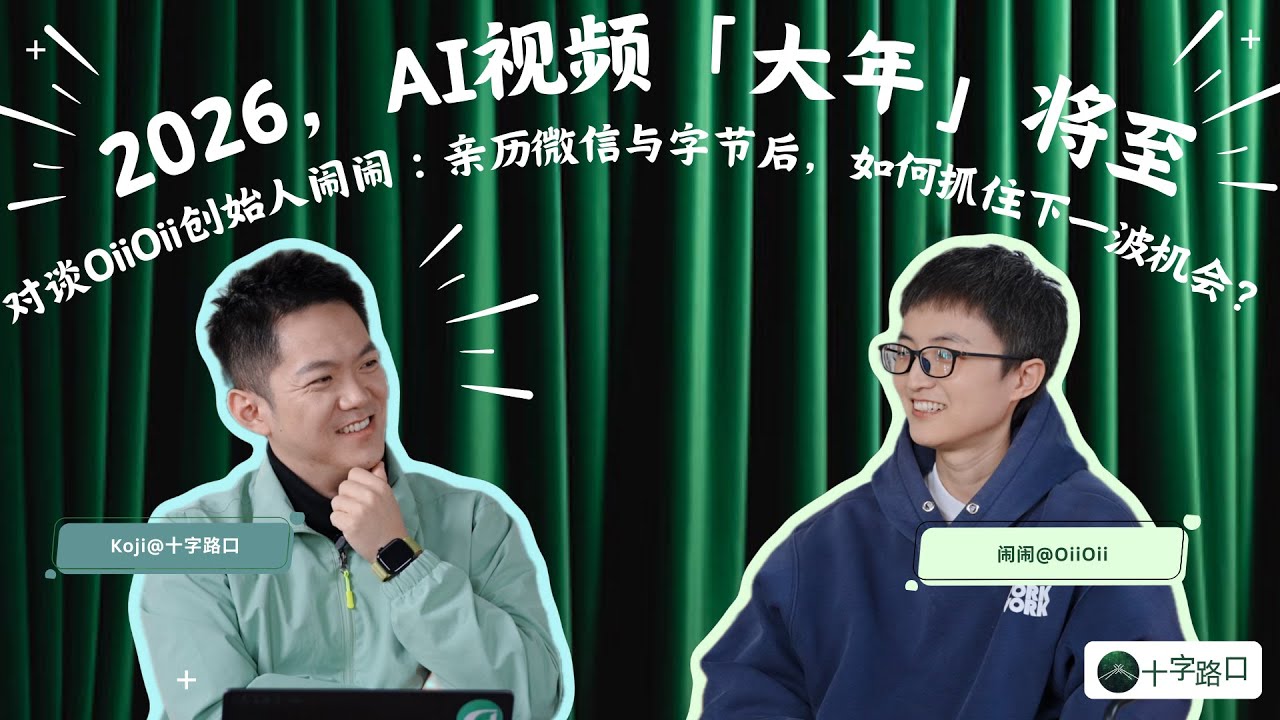
Hi, I'm Koji. This week at Crossroads, we'll record a podcast while driving. This week's guest is unlike any we've had before. He's Kevin, the founder of ChatCut. For the past 10 years, his career has been in directing, and as a director, he's quite impressive.
His first short film, Niezong, was nominated for the Golden Horse Awards. I'm driving to their office now to pick him up. It's this beautiful white building. That should be their office.
Hello.
Hello, hello, hello. Nice to meet you. Wow, this place is really special. It doesn't feel like an office.
Thank you. Thank you. Welcome.
Yes, how did you think of using this place as an office?
It's, uh, Urumqi Middle Road. I've always liked that street in Shanghai.
I like it too.
Yeah. Uh, it's like a crossover with a bit of a multiverse feel. Italy, just pull it aside, and there's a genuine Hui noodle shop. It's so vibrant, and walking down this street, you might hear someone speaking English, Shanghainese, Mandarin, or even Vietnamese, and you just get the sense that this place has a special kind of energy.
Yeah. Let's take a look around the office. Hey, what's this staircase for?
There's a tent up there. Ah, and if a colleague wants to take a nap, they can go up there for a rest.
Wow. I wasn't tired, but seeing it makes me want to nap.
And, um, this is roughly our work environment.
Hmm. Wow. Oh, so cool.
Yeah.
Wow. Nice.
Yeah.
Hello, Li Shang. Navigate to Dianhu Peach Garden.
How long have you been doing this podcast?
It has been two years. Um.
Okay.
One hundred episodes.
Yeah. What is the frequency?
One episode per week.
One episode per week? Okay.
Yes. This is our first time recording like this. I could make this into a series, which might be quite interesting, going to different places each time.
This is a good series, Founder's Cars Going to Places.
Yeah. Already driving away from the city center. Let's start with quick questions and answers first. Kevin, may I ask your age?
1992.
Wow. What school did you graduate from?
Rhode Island School of Design.
MBTI and zodiac sign.
I took the MBTI long ago. It's outdated, so I won't mention it. Zodiac sign is Pisces.
What do you think your current MBTI is?
INTP.
Can you describe ChatCut in one sentence?
Editing videos in a conversational way.
What's the current funding situation?
Around 10 million RMB in a seed round just completed.
What about our revenue and profit situation?
It's not easy to disclose.
What's the current team size?
10 people.
What did you do before starting your business?
Before starting the business, I was a documentary ad director, worked at Vice and Discovery, founded Homework Production, and got nominated for a Golden Horse short film in 2024.
Hey, we're driving out of Shanghai now, so we can talk about your journey. When we reach our destination, we can discuss AI and the AI product ChatCut. I remember you once told me that leaving downtown was a key moment in your life.
Which year was that? '22 or '23 during that period.
The Escape3:35
At that time, I had just finished shooting a large number of commercials and documentaries. Then, I encountered a rather unique period in Shanghai, which unexpectedly gave me much more time than before to pause and engage in deeper reflection and thinking, like suddenly, "How did I end up shooting commercials?"
How did you start shooting commercials?
In late 2016, I joined Vice Media and was sent to Vice China. When you're in the US working in this kind of media, you can earn revenue directly from the platform. But in China, like back then, you put your videos on iQiyi, Youku, or Tencent, relying on that.
It was almost impossible for them to share revenue with you based on traffic.
Got it.
So in China, there's an additional commercial department.
So when you first joined Vice, you initially thought Vice was a place for free expression and creating your own content, and then after coming to China, you realized, "Oh, that's how the business model is here."
I never saw that as a problem. In fact, I was the one fighting to take on those commercial projects because with commercial projects, you have a budget, more people to collaborate with.
You actually embraced the commercial side.
Completely and actively embraced the commercial side. Well, partly, it, it was actually out of curiosity from a learning perspective. When money isn't an issue, what ideas can we bring to life?
Mm.
And then from a business perspective, I think back then, just after graduating from college, if I made a short film myself, no one would be interested in it, right? But if you say, "I shot a project for Burger King," even if we don't watch it, it seems like this guy has some skills since Burger King hired him.
I mean, if you've shot for Adidas, what kind of person must you be?
Why did you escape after shooting for two years?
In advertising, there's a tangible improvement in skills, yes, but there's also this part that's about vanity, and once the purely vain part is gone, my interest in doing pure advertising isn't as strong. Advertising is a complex process. You have the idea, but you still need to convince actors, clients, and all the parties involved.
It's chaotic. When I saw many people who were really good at this, um, I realized that everyone has their own niche. If I force myself to compete with others on the overall quality of an advertising director, um, I don't think it will necessarily lead to a particularly good outcome.
At that time, had you decided what to do next?
The place we're going to now also gave me a lot of inspiration.
Wow.
At that time, we were also shooting a project right by the lake. Okay. And when I went to scout the location, I thought, "Wow, this is amazing." There was an agency nearby. I just said, "Let's take a look."
Just saying it might not be very realistic to move there. So we went to take a look and ended up liking a house. Sometimes it's not that you made a decision, it's more like the hand of God is nudging you, and you think, "Oh, that's the one."
The House of Love at First Sight.
Right. I think no matter what, let's step back first, then we can think about what the next step is.
Was that the time you started filming Nizong, later nominated for the Golden Horse Awards?
That was the time when I started wanting to do something of my own. It could be a film, a product, or an app. For this year, I decided I won't take on any advertising projects, so I'll just hold on to an idea for now, even though I'm not exactly sure what it is yet, but let's just keep it there for a bit and let it slowly germinate.
I wrote many, uh, short films, and Nizong was one of them, and I managed to shoot it that year. Actually, while shooting Nizong, it was also around the time ChatGPT just came out. Oh, so I started using a lot of AI in my life and also came up with this ChatCut idea.
You just use ChatGPT and then started editing with Premiere. You can feel the intersection of these two eras.
Feel like I'm traveling through time between the future world and ancient times.
Yes, yes. Um, and I've been pondering this card-tearing project, and God will definitely make it happen. But, um, is it God who wants me to do this? Or maybe I should be the one to take on this task from God.
Um, it's about solving an ordinary person's problem, which sounds both simple and difficult. It's not about how skillful your expression is.
Right.
Rather, it's about your simple yet profound insights into life's problems.
Mm.
And on this point, compared to someone with a pure engineering background, I feel I have certain advantages. If God were arranging it, He might not choose me, but if He hasn't pointed someone out yet, I'm raising my hand.
Yeah.
What are the stages in between?
From the moment you first had the idea to now, I've been digging deep into what kind of app this really is. Um, at first it was like a ChatGPT or a cursor for video editing, but what does it really mean?
What kind of app will it be once it's launched? So I started brainstorming, and then during the Golden Horse Awards period, I happened to meet Eric, who was actually a partner at Antler, a VC from Singapore. He would directly say, "After spending some time with you, I'll give you a small amount of money, and let's see what you can do with it, um, to see if you have the perseverance to do something."
And I'm fortunate that the first investor we met was one of those legendary empowering figures.
What do you mean by that?
There are many people whose personal abilities are very strong, and they have a lot of charisma. But when you sit next to them, you feel, "Oh, he's so strong. I'm so insignificant. I'm nothing. How can I compare?" But some people, with their strong personal abilities, amplify the abilities of everyone around them.
I remember you once shared your impression saying you'd met a lot of VC investors. A lot of them are looking for reasons why you can't succeed in this.
Yeah, yeah, yeah.
But Eric keeps looking for reasons why you'll succeed.
Yes.
Mm.
Exactly. Finding reasons why something can't work is easy. Most things in the world don't work. If you're looking for faults, you don't even need to try.
So after getting funding from Antler, you started working on it. Was the first version released smoothly?
Well, you know, back then, our target users were actually, you could say, relatively professional users.
Professional users.
Um, actually, the basic idea of ChatCut is to transcribe video into text in some way because from our editing experience, a lot of editing happens within Word documents.
Mm-hmm.
Editing seems like a multimodal task, but in reality, when an editor is editing, most of the work is based on text. So ChatCut may have two core aspects. One is using a clever way to transcribe the video into text, and the other is the part where AI truly adds value, which is how to rearrange the transcribed text into a new edit and then use engineering methods to map it onto the timeline.
In our first version, we actually only achieved the first part. We just transcribed the audio, allowing people to edit the video by editing the text transcript. It didn't even have AI editing capabilities. In the following versions, you know, ooh, it was only by April that we began to have a prototype of AI editing.
So initially, there wasn't enough time to do it, right?
If you have one thousand true fans who will use whatever you put out and pay you thirty dollars a year, if you serve them well, you don't actually need to scale up significantly. It's more like a business, a small but beautiful product.
At that time, we did not aim to create a, a scalable, large AI venture capital-backed startup. Um, we just were not ready for it. So what we could do was create a minimum viable product, find your first customer, then your first ten customers, and the first one hundred people who would continue using your app.
Now, my perspective has changed, but at that time, I thought it was a good learning experience. For example, if your child goes to study in the US, it's better not to suddenly put five hundred thousand dollars in their account.
They might quickly pick up bad habit.
So you mean that starting with limited resources allowed you to experience and learn more?
Others might have their own methods, but for me, it was a particularly good learning path.
Background11:50
Hmm. Hey, this makes me think, actually, you are from Anshan, Liaoning.
Yeah.
Then you went to the US directly for high school?
Yeah.
And at Kent School.
Yeah.
It's a very good high school.
Mm-hmm.
How did you manage to do that?
When I was young, I was, uh, an above average student in my class, not an exceptional one, but I was particularly curious about the outside world. For instance, I watched every movie I could, listened to every piece of music I came across, especially if it wasn't in Chinese.
I'd think, "Hey, I'll give it a listen." Others couldn't understand it, but I'd pretend that I could. And my dad was quite supportive of my interest. But when my dad was on business trips, there was something called damaged CDs that were sold by the kilo.
My dad would just buy a kilo, and when we got home, I'd listen to each one, one after another.
You must have had so much fun opening a mystery box each time.
Yes, exactly. Back then, it wasn't just a mystery box. Even after opening it, it was still a mystery because it wasn't like you could open it and see Nirvana, then go online and find out others said it was good because there wasn't internet back then.
You had to build your entire evaluation system yourself. Whether it was good or not was entirely up to your own judgment, using your own eyes and ears to listen.
Mm-hmm.
And I was so curious about foreign cultures that my English was really good by middle school.
Mm-hmm.
And then it was just that Kent happened to come to Shanghai for those interview admissions.
But how did they find out about you? Or how did you know Kent School coming while you are in Anshan?
Yeah, it was from some research I did back then. Um-
You decided to attend high school in the US, so you started researching.
I wanted to go to high school in the US, yeah. One reason was that I was very interested in the outside world, and when I watched American movies, I felt that was where my soul belonged. Of course, later it wasn't exactly as I imagined, and my mom was a high school teacher known for being quite strict, so my grades wouldn't have been an issue to attend her school.
Back then in Anshan, going to high school in the US was still very rare.
Almost no one did it. No one. Yeah.
Wow.
Ever since then, whenever I encounter something new or go to a new place, I just don't have that feeling anymore like, "Oh, uh, uh, what could this be like?" Et cetera. I might be unfamiliar with everything, but will I face any problems?
It's okay. Just let's try it. I feel my ability to handle risks is very high.
Hey, when he came to Shanghai for recruitment, which stories or traits about you do you think impressed him?
When I was in middle school, I started selling damaged CDs. First, I had sales skills, and second, it showed just how much I genuinely love this thing. In middle school, I loved music to the point of obsession. Hmm.
While others brought snacks like bread and cookies on spring outings, I carried all my damaged CDs in my backpack. Then as you walked by me, I'd put the earphones in your ears.
To promote them?
Yes. I mean, listen to this. It doesn't matter if you buy it or not, but when you hear it, am I the only one who thinks it's good? Like the first time I heard The Beatles, the first time I heard Nirvana, I thought it was awesome.
Then you listen and you think, "If I shake your head a bit, how could you think it doesn't sound good? It sounds amazing."
So this is a very passion-driven startup.
It's a completely passion-driven startup. Hmm. And I still remember buying, for example, a first edition of a new album by Blink-22. Hmm. So back then with that lighter, other people had burned through theirs a lot, but mine was barely used, so my track didn't get played.
Wow. Then I called my classmates and said, "Hey, you know what? I got a first edition of a new Blink-102 album, and now on the phone I'll play it for you directly." Then I turned on my stereo and listened through the phone.
I said, "Isn't it awesome? Fifty bucks. Buy it or it will be gone by tomorrow." I said, "Save two for me." Wow.
Yeah, it sounds like a very joyful venture.
Yeah, it's very satisfying even if no one else buys it. Keeping it for yourself is also a personal asset, right? You won't be troubled if it doesn't sell. This kind of business model is really cool.
Actually, uh, as a startup, whether you succeed or not, no matter how capable you are, a lot is determined by fate. Um, but I think as an entrepreneur, what you can do is choose to do something where if it fails, it's okay.
The thing we are doing together and the people we're doing it with, whether it succeeds or fails, means our process is definitely worthwhile.
It's easy to end up studying business, economics, or computer science along this path, right? But then you went to the Rhode Island School of Design.
When I was in high school at Kent, I fell in love with film. At the time, I had several film schools to choose from. One great thing about the US is it encourages you to visit colleges, and when I went to the Rhode Island School of Design, I instantly felt that the people there were so different.
Their hairstyles, their clothes, the things they listened to and watched were things I'd never seen before. It felt like I'd landed on a completely different planet. It's a place that particularly encourages independent thinking. So the startup founders it produces seem to have a soulful kind of startup, for example.
Which ones, for example?
For example, Brian Chesky and Joe Gebbia's Airbnb. Yeah. And the founder of Family Guy went to Kent School and RISD. They're my alumni.
You have quite a unique experience. You might not find another person from Anshan with a similar experience.
There's a writer named Kurt Vonnegut who calls it dancing lessons from God, and I'm willing to take dancing lessons from God. But the Northeast is actually a relatively conservative place, and maybe there's been a genetic mutation with me.
And there are indeed very few people with this adventurous spirit in the Northeast, and it's becoming even rarer.
Director CEO17:42
They say a director is like the CEO of a film set because they have to coordinate everything, and now you're really a CEO. Having been both types of CEO, what do you think are the similarities and differences?
I think there are many similarities. For example, a director, it is a challenge of comprehensive quality. You have your own understanding of the world.
Mm-hmm.
Then you have a vision, but having a vision is just the beginning. As a director, you must possess the capability to attract investors who provide funding to bring together a skilled crew and to draw in talented actors. Furthermore, you need to inspire all of them to work together towards realizing your creative vision.
Achieving this is not easy. It demands that you have a strong ability to withstand setbacks and overcome challenges along the way, and a thick skin and the persistence of visiting someone three times before they agree, and ultimately taking complete ownership of this vision.
Another particularly similar aspect is that a director's work is always from zero to one. Each film is a completely new one.
It's always day one.
It's always day one. I always have to quickly enter an environment outside of my comfort zone. Hmm. Completely creating something from zero to one. This is extremely similar to entrepreneurship.
What about the differences?
I think the biggest difference is once a film is finished, it's set and doesn't change. But on the day when an app product is launched, you are actually just beginning the process of shaping, step by step, what it will ultimately become in the end.
It requires a major shift in mindset.
That was from the work's perspective. From the management perspective, or just from running a company, because making a film is actually like running a company-
Yeah
... a temporarily assembled organization.
Yeah.
How is this similar or different?
I think the organization in filmmaking is purely about selection, not training.
Okay.
When an advertising company selects a director, they must have, for example, if we are shooting a car commercial, this director must have previously shot five identical car commercials before we would consider them, because this work can't afford even a millisecond of error.
It's more like a SWAT team than a company. Making a movie is just like that.
Task force.
Yes, a task force, and in a task force, it's not about idealism, like talking about ideas. Of course, you talk about ideas, but when shooting, it's a military operation. Decision-making requires a certain level of authoritarianism, like, "We're not discussing this, we're just doing it this way."
When running a startup, you need to have a long-term attitude towards people. If you wanna build a truly good startup, you should treat people more like an investment.
Do you think there's a sense of dictatorship in being a film director versus being a startup? How would you view these different management styles?
I think a director might appear to be a very dictatorial role.
Hmm.
But actually, when it comes to any good manager, you know, dictatorship just really doesn't work at all, whether it's managing a company or a broader kind of dictatorship. It's already been proven by facts, and the reasons are obvious.
If you can find people who align with you and inspire others' abilities, then 10 people working together on a task will certainly achieve much more than a single genius who is dictatorial.
So what style of manager are you?
I've always seen myself as the person paving the road, so when everyone arrives, it's very smooth. Everyone has a consistent understanding and clear expectations of the project, allowing it to be completed smoothly. Well, as a CEO, I honestly believe that my real job is actually to make the road as smooth as possible for everyone.
Who sets the goals for your company?
We discuss our company's goals together. I work with my current product colleague, who is now our partner, and he has experience in large companies. We combine a special forces-like methodology with my intuitive judgments. We complement each other fully, and together we set goals to achieve.
You moved from working in a non-tech industry to starting an AI company. Today, many people in their own industries also feel a sense of being trapped. People wanna break through this feeling of being stuck. So do you have any suggestions on how to get out of that rut?
In my view, things aren't achieved by talking about them or just by learning. They're accomplished by doing. One advantage of AI coding now is that you have no excuses. Basically, there's no excuse not to take action now. Taking that first step is really easy.
We were just talking about how you received funding from Antler and developed the first version of your MVP product. Later, ZhenFund invested, and it was an investment led by Liu Yuan. Do you have any stories from your interactions with Liu Yuan?
Fundraising22:07
At that time, even without any marketing, we already had many paying users. The next slope is significantly higher than the current stage, and for that, you truly need a VC-backed startup.
Hmm.
At that time, I started returning to the country to raise funds. During that month, I did nothing but meet investors one by one. I felt like GPT undergoing intensive reinforcement learning. Hmm. And during that period, I met Liu Yuan.
I feel like the hand of God brought the two of us together. In such a vast country with so many investors, out of all the investors and startup founders we could meet, he's someone who really loves movies. In running this AI startup, he needs a lot of rationality, but also a lot of sensitivity.
Sometimes when you look at data too much, your sensitive side gradually gets erased. Very few people can maintain their sensitivity and naive perspective on the world. Liu Yuan truly possesses sensitivity and genuine curiosity. What impressed me the most is that we talked about many movies.
Initially, I thought he was just putting me in warm water to eventually boil me. I also recommended him many movies, and he text me at 2:00 AM saying, "Hey, Kevin, I watched that movie you sent me." He is genuinely curious, and I think that's really rare.
So how exactly did your shared curiosity about movies eventually lead to this investment happening or, or your shared pursuit in your careers and mutual recognition?
He was genuinely trying to fully understand me.
Hmm.
Then, you know, he saw a model of me, and after that he was able to sort of make a judgment about my future. He doesn't like the correct answer. I haven't discussed this with him, but if there's a choice between A and B, it's like horse betting.
A has a 70% win rate and B has a 30% win rate. In a rational situation, most people would choose A. But even if you're right, you won't feel much satisfaction unless you make a unique choice that proves right while most others are wrong.
That's when you truly feel more satisfied. In this regard, Liu Yuan and I are exactly alike. Uh, it's just doing the right thing. Maybe it's okay, it's fine, but if you do something that makes others lose face, that's even better.
Everyone seeks new experiences.
Yeah, yeah.
You said after meeting many VCs, you built a reinforcement learning model.
Yeah.
Any tips for founders still starting up or fundraising?
First of all, try to maintain a calm and steady mindset. No matter what, you can't develop a perfect pitch that works every time. That doesn't exist. There are many VCs out there, and you need to find one with whom you have chemistry.
Yes, because investing isn't a one-time thing. It's not like you invest and then leave. Rather, everyone stays on the same boat for a long time.
Like starting a long-term relationship.
Yes, it's the start of a long-term relationship, and the way this unfolds isn't like, "Oh, I'm gradually getting closer," and then finally the deal is done. Rather, it seems impossible before it actually happens. So you just face rejection and then move on to the next one.
Uh, not everything can be reduced to a method. You just have to keep trying different things until something works. There's no set formula. It's all about the right timing, place, and people. And if the timing, place, and people don't align, then it won't work out.
Lake Reflection25:44
Wow, it's so beautiful here.
Yeah, so this is kind of where we filmed, you know? When I was out scouting for locations, I actually saw this place. It's a huge lake.
Yes, it's like a sea.
Yeah, yeah, yeah.
That's awesome.
Yeah. After I started doing ChatCut, my high school was a place where all my classmates were very wealthy. Um, I used to be really envious of them, but after I started doing ChatCut, when I told them about what I was doing, it was the first time I could feel the envy of the wealthy towards me.
Wow.
Having something to do, you know, is really your greatest wealth.
Agree.
Yeah, yeah.
The most painful period in my life was during 2014 and 2015, which was when Zhumei went public. At that time, I was about twenty-nine years old, and I also had a bit of money.
Yeah.
Then I resigned without a plan.
Yeah.
Then I went to America and stayed at a friend's house.
Yeah.
He had already bought a lake view house at that time, but he had to go to work during the day. So after he went to work, I'd just lie on the large white sofa in the living room, surrounded by the lake on three sides.
The first day, I was in a great mood and even geared up to go jogging around the lake. Then the second day, the third day. By the fourth day, I started to feel what depression was for the first time.
I felt like no one was reaching out to me. I checked my phone and still no one was reaching out. It was like the world was drifting away from me and no one cared. I didn't know what kind of connection I could have with anyone.
It was truly a massive pain. Then I realized, from now on, I must find things to do.
Yeah.
Just lying down is not happy at all.
Yeah.
Mm-hmm. How many months have you lived here?
Lived for a year.
Oh, a full year?
Yeah.
All four seasons were experienced.
Yeah.
Hey, what was the lifestyle like when living here?
I had a car at the time, and I went to Sam's every two weeks to buy all the food. I was quite conscious about health back then, so I made sure to walk a lot and work out every day.
Hmm.
I started meditating back then.
At the beginning and end of that year, do you feel you changed in any way?
I feel like from the beginning to the end of that year, I was a completely different person. Uh, before, I was a documentary director in Shanghai, but after that year, I felt I could break free from that identity or any identity, and I had a stronger resolve.
Mm.
Yeah.
How much were you earning per day as a director back then?
Fifteen thousand US dollars a day.
Wow.
And that was just normal life, you know? It's like I show up, it's like... But I think directing is a business without leverage.
Trading time for money.
After coming up with the idea for ChatCut, I thought, "Wow, this really has great leverage, and I'm still doing what I love."
So up to now, you still enjoy most of the process of working on ChatCut, right?
Hmm. So there's actually this book. It's called Man's Search for Meaning.
Uh-huh.
It's quite a famous book.
Hmm.
Enjoying the process and experiencing pain are not contradictory. It's more about whether you have belief in what you're doing and fundamentally think it has value. If you think what you're doing has value-
Mm
... the more you suffer, the more you enjoy it in the end. It's proportional.
Yes, the more you suffer, the more you feel enjoyment.
It's like in a movie. If you don't go through the eighty-one hardships and just arrive in the West for the scriptures, it wouldn't be a fun movie.
So you're actually anticipating some hardships.
Film and television are truly pure high-intensity stress tests.
Hmm.
You know, the things that can happen on set are honestly really hard to imagine actually happening in your daily life. And now for me, not speaking from other perspectives, but just from a stress resilience angle, there's nothing that can touch me when hardships occur.
Every hurdle is overcome.
Yeah.
And then you start becoming more confident that you can solve many problems.
Yeah, even the assumption that difficulties are tough, or is it that you're aiming for what's behind those difficulties?
Hmm.
But the work itself is the point, not just what's waiting at the end. That is to say, if this work doesn't exist, it means I have no job.
Interesting.
The obstacle is the way.
Uh-huh.
There's a book called that.
Yes. Obstacles themselves, hardships themselves are a way of life. They are the path itself.
Yes.
When you were directing, when you were filming, what was the biggest hurdle you encountered?
Honestly, there isn't one single major hurdle. You know, everything goes wrong, and I feel like it's kind of similar to facing hurdles. The assumption that everything goes wrong is that it's supposed to go right, but actually, my mindset is nothing's supposed to go right.
Uh, you know, of course, it goes wrong. That's just the job.
We made it to the lake.
Yeah.
Is this a place you often come back to?
Yes.
Under what circumstances do you usually come to the pavilion in the middle of the lake?
Before, I lived in a small house behind In the morning, the first thing was coming here
Oh, let's talk about ChatCut again.
Yeah.
ChatCut30:38
Actually, what ChatCut is doing is using natural language to help with video editing. Some think this future is inevitable. Others think it may never come. As I understand it, you definitely believe it will happen.
Yeah.
That's why you chose to do this.
Yeah.
So when you think of it, what kind of picture do you have in your mind now? Can you depict it now?
I don't think it has to happen in the future.
Hmm.
I think in the past, videos were edited this way.
Hmm.
That is, the video might be something edited by an editor using Premiere.
Right.
But videos are all edited through conversation, where the client holds a WeChat and says, "Put this shot here, put that shot there," all edited through conversation. If you need very precise work, sometimes it's faster to move something one frame by hand than to explain it, and mistakes can happen.
For example, this long interview we have now. Right? Then throw it into ChatCut. For example, you can say, "Those points mentioned earlier shouldn't be included."
Hmm.
"I remember this sentence was very good, so I put it first."
Hmm.
"Then help me add suitable music. Help me add suitable MG animation."
Hmm.
You can say such a sentence, and it can help you edit out a rough effect. So I think when it comes to the future form of this app, honestly, I don't really think it needs any super dramatic changes in its appearance or anything like that.
Okay.
For example, an editor is a problem that has been solved, like Premiere, Final Cut, DaVinci, and even CapCut. They have a 99% overlap in terms of editors. They are highly similar because they have been refined over time. This wheel is already round.
Don't want to reinvent the wheel.
I don't think creating another wheel has much value.
Yeah. If our vision is to make a natural language video editor, how many steps do you think it will take in between? What are each of those steps?
Yeah. You don't have to completely create this wheel, but you have to go through the process of making it, 'cause you can't use Premiere as your base and directly modify it within Premiere. You can make plugins get, you know, but you'll be constrained by others.
You have to make this wheel, oh, to some extent. But the most core part is the AI, which is still the abstract part. It's about how to help someone do the work of an editing assistant, mastering the actual workflows within editing.
It's not about having so-called innovations on the interface. AI primarily addresses this function, which is above the editing software. It's on a, a conceptual level. ChatCut is experiencing a phase where AI is like an elementary school student, but the next step is to send the student to high school and university, and then let it have its own understanding of the world.
When you put in the footage, it might not need you to tell it exactly what to do. Instead, it sees the material, understands it, then explains how to do it, and edits a video that's above your level.
So the first step, are you still making another editor?
The first step is really our work, and it might be a pretty balanced development. There are elements of a compiler in there. There's also the AI component. So it's a fairly balanced kind of development. It's not just about creating a compiler.
Then after we finish creating the editor, hey, it's AI's turn. We go to develop that AI.
So over the past year or so working on ChatCut, what is the question you've thought about the most?
The core issue might be about stylization. Where does style come from?
This style refers to the style of the film, or...
It's the style of the film.
Okay.
When you're watching someone edit, there are two levels of editing. One involves right and wrong. Like, if you say something in the middle, and bam, the sentence is cut off before it's finished.
Right.
That's wrong. I told you to cut out filler words, and if I see they're not removed, you're wrong. But once you've already dealt with these basic issues and there really isn't a clear right or wrong anymore, then every YouTuber or every independent media creator now tends to have a really strong personal style.
Yeah.
Throughout the entire editing process, you need to understand this stylization, how you use AI to replicate this stylization. I think this is something still being explored, and no one has an answer yet.
I see. The difficulty is the lack of a feedback loop for reinforcement learning.
Yeah.
The reason AI coding can develop so quickly is because there are bugs. It has bugs. So it's very easy to get feedback for reinforcement learning from this. But what makes a film look good?
Uh-huh.
This is very subjective, very stylized. While you're thinking about this issue, how do you think it could possibly be solved?
So for example, when I'm, you know, editing a Vice film or maybe a Discovery film, my mindset isn't just, "Okay, Kevin Li is here."
Uh-huh.
We bring out our own style. It's just us doing some editing.
Uh-huh.
Instead, you know, you follow a process, and basically you adhere to your own workflow.
Hmm.
And because I use such a process every time, I don't let my ego get involved. Instead, even though there's a lot of material, we first watch the interviews. Then there are also many interviews, which makes it hard to remember every single point.
We start with a Word document, which is why I mentioned earlier that a lot of editing work is text-based.
Hmm.
So every time I follow such a workflow, it ultimately leads to the formation of my style. That is to say, it's not just a matter of going from point A to point B. If you approach this with traditional engineering thinking, A is A, B is B, then just use reinforcement learning and expect miracles.
This is like the gone astray phenomenon described in Chinese martial arts novels, where you're forcing it without finding the key to the problem. But if you observe how someone starts with this step and uses such a technique, the final film turns out this way, and it naturally helps you form that style.
So how can this be transformed into a capability of ChatCut?
The next step is to capture the real workflow of editors, turn it into workflows for different agents, and then observe their different performances in various contexts and materials. Many things require human definition, which is because I think you're absolutely right.
A lot about editing is based on human common sense, which hasn't been internalized into the training data of the language model. So in some workflows, there's an order of what to do first and what to do next. These small details, like checklists, actually play a large role in determining the final outcome of a film.
Today, there are many tools for AI video production, and everyone has different paths, but there are many key decisions like choosing which model to use.
Another key decision is, um, how much freedom do I give to the user?
Mm-hmm.
Should I create a workflow?
Yeah.
Should I use generated footage, or should I fundamentally only use footage shot by the user?
Yeah.
In this series of various key choices, can you talk about which ones you believe you have made that are very clear and certain choices?
Our goal is as clear as one plus one equals two. The reason is because we are the users ourselves. Sometimes when posing a question, you can directly think about what the needs are of people who are shooting and creating every day in real life.
But I think AI-generated videos haven't brought a significant impact to the real world. For instance, when you're sitting on a plane, what is the person in front of you watching? Then when you see someone scrolling through Douyin on the subway, what are they scrolling through?
How are these videos edited? It hasn't changed at all. How are these videos made? It hasn't changed at all. So the world is contradictory. Some things seem to be undergoing drastic changes every day, a daily revolution, but some things, like us sitting by the lake, haven't changed at all.
We've always compared our AI to a blue-collar worker. It's the most down-to-earth AI in the world, addressing the most genuine workflow of creators. Suppose in this workflow, you solve a problem and you solve it well, that's a billion-dollar business.
For example, Frame.io, that's a good product. Their business is video review, basically film screening. It's such a niche market, but it's a multi-billion dollar company because it solves a real practical problem in the real world, even if it's not flashy.
Ah, there's another perspective that video editing is actually interlinked.
Yeah.
The example you just gave about reviewing the film is actually not part of the editing workflow.
Yeah.
Because editing is so interconnected, people are very cautious about changing their workflows.
是的 .
Uh, up to now, have you seen any trends emerging? At what stage of editing-
Yeah
... what changes might AI bring?
I think, uh, your assessment has been completely validated in our reality.
Why?
For a professional editor, it's very difficult to disrupt their workflow. We previously targeted a lot of professional editors, and this is one reason we changed our target, realizing the vastness of the ecosystem. We can't create a Premiere and add AI on top of it.
That's just not feasible.
So you've redefined your target user group?
Yes, because you realize it when your tires hit the ground. What excites me most now is that our users may not have been editors before. For example, he's someone who has always wanted to create content and start a personal media channel.
Hmm. And before, he felt that creating content, specifically editing, was the reason he wasn't doing it. It was too difficult. Now, filming is really simple. You just take out your phone to shoot, and it's no worse than using a camera.
Yes, but editing is the most critical bottleneck. Hmm. And I think addressing this issue for them, we can help them achieve an eighty out of one hundred instantly, providing immense value, even more than increasing a professional editor's efficiency by one point three times, which I think is more valuable.
Hey, can you give a specific example here? Like with the new target users mentioned earlier, what kind of new videos have they edited using ChatGPT, AI?
For instance, uh, with other AI video apps, you can immediately tell which one was used. This one's Google Lens, that's Clip. If there's water, it's Dream. And if it's a comic style, it's definitely something else. But with videos edited using ChatCut, you can't tell.
There's no AI trace because it only touches editing. We don't generate any pixels. It only creates the animations, just like using AE to make MG animations. So among our user base, we found those videos. They're vastly different, a wide variety.
For example, a teacher found out that if he directly throws his courseware or outlines into it, he can make them into MG animations. Then I record a video of myself, edit it a bit, and I can directly create my own media account.
Then there's the real estate videos. He can now make those himself directly.
I see another approach that actually targets the same users as you do. I don't want to serve the most professional users. They're doing fine with Premiere. I want to serve those who want to express through video but don't have the capability yet.
That group is vast. Some products help these users by generating videos and then editing the generated videos into a complete film.
Because there's an assumption that having users shoot their own footage is challenging. Although filming itself is easy in terms of tools, expressing yourself through visual language is actually very challenging. Therefore, they just need users to have an idea, translate that idea into visuals, generate visuals, and finally combine them into a film.
But clearly, this is not the path you've chosen.
Regarding this, we clearly have a different understanding and judgment about the future. What's the fundamental reason for video's existence? It's a medium for communication between people. But if the content isn't related to the real world, it's hard to connect with someone.
For instance, oh, you record a rough video, but it's you, a real person, telling a story to an audience. The kind of response it can trigger isn't something that a lack of professionalism can cover up. This person is full of vitality.
You know, AI can replace many things, but I don't think it can replace this core element. I think generating is a creative method, one of the artistic techniques. But if you think generated content can replace someone else's filming, that's a misjudgment of the world.
Hmm, you think partial generation is possible, but not full generation because fully generated content lacks the real world's appearance, making it hard to move people. Even though AI has made many breakthroughs today, there are still many things it can't do.
So from now until a day when a natural language-driven video editing ChatGPT is created, what technical challenges need to be overcome?
Firstly, the context limit. What's that called? The context limitation. This definitely needs to be overcome because video consumes a large number of tokens, and the current context limit is a problem. Then there's the development of multimodal models, which haven't reached a truly mature stage yet.
Google with Gmail has made a good start in understanding audio and spoken content to some extent, but it hasn't reached the precision needed for editing. I think breakthroughs in multimodal models and context will be significant.
Well, you see, Cursor was actually founded because, you know, it was trained on a really large amount of code.
Yes, yes.
But to create something like Cursor for video editing, which is what we're doing, there's not as much open source code because video editing relies on knowledge that's all in the mind. Without this knowledge, without these things, how can you train an AI to effectively help people with editing?
What approach are you taking to accomplish this?
Editing doesn't have as much code, not because it's harder than coding, but because it involves a lot more common sense. And common sense is something LLM inherently possesses, which is a prerequisite. Additionally, I think editing should be improved in two areas.
One being things that can be validated, things that are as precise as pointing and hitting. For example, if I want to edit out a verbal slip and turn it into a TikTok style video, did it automatically convert it into a vertical sixteen to nine format for me?
Some things can be verified while others are about good or bad, that kind of thing. I think if it reaches the first level, it already provides tremendous value. So if one day you can really just point and get what you want, as long as you can express yourself a little more clearly, just say what you want a bit more clearly, I think that alone would bring enormous value.
Also, we need to use our own platform to collect this information. One part is optimizing our prompts, and another part, I can't say whether it's right or wrong, is whether this is something that can be achieved by a sequence or a single model.
But I think without those codes, that's true. However, one advantage of creating our own platform is that we accumulate this information.
You're actually challenging something very difficult. We were talking on the way here thinking that this is something God would definitely choose someone to do because it is bound to happen. Who were you thinking would take on this task from God before?
Yeah.
Hey, no one answered.
Mm-hmm.
Then you took it on. So why did no one take it on?
That's a-- Wow, interesting.
Because actually there are two states of entrepreneurship which are different.
Mm-hmm.
One is that ten thousand people are doing what I'm doing.
Yeah.
The other thing is what I'm doing, no one else is doing.
Yeah, I understand.
It seems like you're in the latter category, but both have their pros and cons.
Well, I think, you know, we're not entirely in the latter category, and honestly, a lot of people actually think we're in the former. You could even say that. And many entrepreneurs think they are in the former category and classify us as such too.
But why do I say no one is taking on this task from God? Well, the reason is that, uh, you know, identifying a direction, finding an entry point, and coming up with a good methodology is actually extremely difficult.
This entry point is a very subtle thing.
Right.
Sometimes it doesn't require you to have a particularly genius or groundbreaking idea. It's usually, yeah, this works, and it's something very simple at a cognitive level. I think my documentary background happened to play a major role here. Documentaries fall under what's called unscripted, which is creation without a script.
It includes almost everything we discuss now in content creation. For example, if you are a YouTuber, what you're doing is creating unscripted content, which is the opposite of scripted content. Scripted content, such as films, involves a strict script that guides the entire creative process.
In those cases, when you edit, the main challenge isn't about deciding which line of dialogue to use because everything is already written out in detail. How do I filter the content? How do I find the logic? Rather, the logic is already set, but how do I find the best performance of this line?
How do we find this line, this scene, where the logic is already fixed, and how can we switch angles to find the best one? I think that's something AI shouldn't touch and can't solve.
Like when Tony Leung says to Maggie Cheung, "I have a boat ticket. Will you come with me?" There are one hundred takes, and if you let AI choose for you, just forget it. Cannot be done. In the realm of unscripted content, documentaries are the hardest because the volume of material is massive, and the target is the most aimless.
Like Wang Bing, when he shot Taxi District for three years, then spent three years editing it down to three hours, it's not like he started with a clear image in his mind and just edited until it matched that image.
You have to face your daily shooting and organically create something with vitality. But once you find this, the workflow is exactly the same as when you're shooting TikTok. Because it's a problem of varying degrees. For example, when shooting TikToks, I went skiing in Changbai Mountain and filmed a bunch of random stuff.
At a relatively low level, you're solving the same problem that Wang Bing, the documentary director, solves. How to find order in chaotic material. Within these rules, there might be three possible guidelines. Uh-huh. But I think this is the most attention-grabbing part.
So it's actually quite a coincidence that before AI came along, I was making a ton of documentaries for CCTV, Discovery Channel, and Vice. So regarding this chaos, this void in the universe on... I have seen it, and what I gained from it happens to be what I want to share with you now.
The biggest trend in content creation growth is that independent media YouTubers are actually all making documentaries. What we're doing right now, you might think it's a podcast, but actually it's a documentary. Also, when I took this step, it was at a perfect time.
It has been one to two years since LLM appeared, but AI coding has just emerged. Then that is to say the biggest impact Antler had on me, as mentioned earlier, is that Antler was the first company to invest in Lovable.
Oh.
So we have unlimited Lovable credit.
Ah.
Then I can, the very beginning, say, "Okay, there's a Lovable, so I'll vibe." So what are we waiting for? But now that I think about it, it was at that time you started to vibe with this thing. Now, there is some improvement compared to you saying now, "Oh, I also want to have this ChatCut idea," and then I start to build this team.
I feel like the timing is a bit late. Hmm. This world never stands still. It keeps moving forward. In this world, there is me, and there are also others, people who are like me, who exist here as well.
You've taken this spot.
I've already thrown my radish into that pit. You can force a radish in too, but life won't be easy for you.
As you mentioned, in the past, we filmed documentaries for three years. Eventually, it needs to be organized into a three-hour narrative line of a story with complete vitality. There's actually some know-how, some methods embedded in your muscles. So how did you apply these methods to the ChatCut product, turning them into features, some of what everyone sees today as featured?
Yeah. There's a kind of self-help theory.
Right.
It says that what a person achieves within a year doesn't depend on the goals they set for themselves. It's about the habits they develop.
Okay.
Then I think this is an underestimated method in AI agents. Many people think AI should work like this is the raw material, this is the result, or this is the context. This is the result I want, and there should be a particularly linear connection.
Hmm.
But in reality, it might be difficult to make people understand that this issue has many different correct answers. When I'm editing, there are too many elements of coincidence involved. I can edit it this way. When I find material, I see this.
Oh, I wasn't looking for this, but oh, I saw this and placed it here, and it works.
Hmm.
There is no absolute right or wrong. So if you use AI to find an absolute right or wrong, it will always be wrong. All you can do is help it develop a good habit.
Right.
It's just that when you have a gap here, you need to look at the material.
Mm-hmm.
Uh, and then when your story develops to this point, you must find a soundbite like this. And when transitioning scenes, you need to do your best to find transition points like these instead of saying, "Here's the element. Here's good editing.
I'll give you one hundred thousand samples." I think it's about finding the subtle points, and the subtle points determine its overall appearance.
Are you a purist of natural language editing? For example, some might think natural language can only solve half of the problems or even less.
Yeah.
Actually, there are still many edits that need to be done by dragging and sliding and the like.
Uh, I think this is the balance we've found. Oh, fundamentally, editing is a human computer interaction.
Right.
Even if AI becomes very powerful, I don't see it ever fully replacing a human. So in check-in, timeline editing is actually an important function, and we also spent a long time building our text editing feature. So fundamentally, it's definitely not one hundred percent reliant on AI to achieve all the editing.
Even if AI can reach eighty percent but leaves room for human adjustments compared to reaching ninety percent where humans can't modify it, I'd rather have the eighty percent.
From the beginning of your work on ChatCut until now, this model has also undergone a lot of development. And have you noticed which breakthroughs in the past couple of years have been the most helpful to you, whether it's multimodal or LLM?
I think it can be divided into two parts. The first part is about how it helps with the product.
Hmm.
It's in terms of the product. When Gemini 2.5 came out, it was a huge help to our product. And this time, 3.0 is also a huge help for us.
Could you talk about what these helps are?
Before, for example, when you used models like Claude or GPT, their context length was just not enough. For instance, a half-hour video might already max out the context. Now, with Gemini, it's one million tokens or even two million tokens.
Previously, the first thing you thought of in video editing was, oh, you need to make a RAG, a vector database, because the first problem to solve is the context issue. But now you don't actually have to solve this problem first.
And then our MG animation feature, a large part of it is actually established.
Because of 3.0.
Because of 3.0. So for MG animation, we also do generative AI, but unlike others, we don't generate pixels. Hmm. I think generating pixels is where I draw the line. We generate code, so in the future, it's like making a PPT for you instead of generating an Ultraman, you know, that flattens your house.
So multimodal progress doesn't affect you much, right? Because you don't generate.
The progress in multimodal doesn't have much impact on us at this stage, but it's something we can't bypass. Next, we'll integrate more multimodal features. One is for analysis, the other for generation.
Okay.
Then we're not saying we completely don't wanna do generation, but rather we don't wanna do an ineffective kind of iteration. It's like someone releases a new model, and we just connect an API to show we're diligent. But in reality, you're not adding value.
We need a good entry point, a good integration with editing on top of the model API, and that's something worth doing for us.
Um, in your view, what kind of future scenario would make you feel that ChatCut has achieved the success you imagined?
I can answer indirectly.
For example, when the Sora demo first came out, before the Sora app, we had just started thinking about ChatCut. The guy skiing saw it and thought, "Why bother making movies anymore? From now on, just use this." At that time, the world was suddenly in a panic.
Then his thing is very distinctive. Like you see it and go, "Wow, Sora is really amazing." It was, in a way, both a blessing and a curse. It limited the creator's involvement because no matter how you prompt, what you create still ends up being something from Sora.
Yes.
Then it's something recognizable, and I think this is something we should first avoid. It's not something that limits others. I think for me, oh, success is something like, oh, maybe ChatCut is like when you write emails or when you use ChatGPT in your daily work.
It has nothing to do with your quality anymore 'cause it's something everyone can use. It actually achieves what's in your heart, the things you create using ChatGPT. At first, you might think, "Oh, with ChatGPT, I can do anything," but eventually it reaches a point where you find your own level.
It's very interesting that first we thought ChatGPT would level everyone's abilities.
Yeah, yeah, yeah, yeah, yeah, exactly. It's like having a friend who knows everything about the world, and you can always control them, so you must be a genius. Yes, but we don't see a lot of geniuses.
Let's talk about the team. I was really impressed by what you shared at the Crossroads open mic. You mentioned that in your team there are many alchemists, this identity. Could you quickly introduce what kind of identity an alchemist is?
Alchemist56:38
An alchemist definitely has a dual identity.
Mm-hmm.
He originally had his own role, such as engineer, R&D, designer, or product manager.
So alchemy can't be a main job, only a side gig.
Alchemy is a side gig. It can't be your main job. Or alchemy is an honor, meaning when you create something and reach a certain level, you're an alchemist. Uh, so you know, its definition is actually kind of like, well, the ancient Greek term amateur.
Mm-hmm.
So now we translate it as amateur, but actually, what is an amateur? It's a person who does it for love.
Oh.
Amour refers to amateurs as opposed to professionals who are now seen as good while amateurs are not.
Right.
But in ancient times, being professional meant you did it for money, and one does it for love. Uh, of course, you know, money is a foundation, but I think that honestly a, a breakthrough in something often comes from a person's inner obsession with it.
But I think now with AI coding, it allows your team to be less redundant in size, and it allows everyone to better realize their own creative potential.
Um, so what features are there in ChatCut? Or what parts that we see today were created by alchemists for love?
So the MG animation was a breakthrough for us, and it wasn't in our PRD or weekly goals. He is our product colleague, and he has an obsession with this thing. Uh, while doing other things, he was always vibing with this.
But just two days after he finished it, Gemini 3 was released.
Oh, wow.
When Gemini 3 was done, it was like, "What the heck? Let's put other things aside and focus on this." And this was an opportunity given to us by fate. Furthermore, there are also people who might interpret this statement as meaning, "Oh, so you don't respect engineers at all?"
Actually, traditional methods exist too, but what I mean is engineers can also be alchemists. Even in this AI era, engineers should also learn alchemy. Only this way, AI won't replace alchemists. If you strictly follow assignments, AI will eventually do the work itself.
Uh-
So it sounds like what you want is to foster a team environment that really empowers and inspires everyone, so each person can freely create brilliant features out of passion.
How do you find such people during interviews? What kind of questions do you ask?
Previously, we might have focused more on the person's technical background and their ability to solve the problems we need to address. Now, I think we focus more on a person's overall quality. It could be that they have a particular love for a certain food or they're deeply passionate about something.
If someone isn't interested in anything, they probably won't have a good standard for anything, and then it's really hard for you to become an alchemist.
This reminds me of how Google talked about the eighty to twenty culture.
Yes.
Twenty percent of the time is for people to breathe freely and create freely.
Yeah.
Just today, Notebook LM was made like this.
Yeah, yeah. Well, I think that, you know, many truly great products probably have, to some extent, a certain degree of alchemy involved. For example, Claude Code. It's like he, he doesn't come from a project proposal. He's just that person who says like, "Oh, I have to make something for myself," and then, "Oh, it worked."
I think that in human history, a lot of what we read in textbooks is about a great person who made significant sacrifices for a great cause and achieved the result they wanted. But often they don't know what the outcome will be.
They just keep trying, and eventually, oh, mixing red water with green water makes blue water, and when you apply this blue water to a wound, it heals. We call it alchemy, but this term actually has always existed. It's called tinker.
Mm.
He's tinkering with this thing. He's studying this thing. They don't know this thing. His job is, "Hey, let's try this. Hmm, nothing. Let's try this. Let's try this again." I think the next thing to learn or improve is how to turn these accidental discoveries into something we can systematically achieve, to systematically create such surprises.
Can it be systematized?
I think it's entirely possible, and that's where the challenge and significance of management lie. If it's just one plus one equals two, that doesn't mean much. It has to be this. Systematically creating it, like the anti-fragile theory, I really like that book.
That is to say, you have to create surprises that work in your favor because the leverage of that is far greater than just one plus one equals two.
Ah, so it sounds like you actually look forward to some surprises happening. Is this also because you haven't yet seen a very clear path to where you're heading?
Hmm, no, no, no. I think it's quite the opposite. It's because I can see the outcome very clearly. So I don't need to hold my team by the neck and say, "Instead of simply following the leader's instructions, it's more about how the outcome comes so easily."
It's as if, "Oh, you can take this path and succeed, or you can take that path and succeed as well. No matter which way you choose, the result is effortlessly achieved. Oh, you wanna take this path? That's fine too," because I feel confident letting them go whichever way since I can see where it's leading.
Uh, when you can hear the music, whatever you play is right. And the opposite situation is when your goals are unclear. Whatever you do is wrong. The boss doesn't know what they want, so whatever I do won't satisfy them.
Very interesting. If life happiness is rated out of ten, how many points do you think you have right now?
Happiness1:02:08
I think I'm at nine right now.
Oh, very high. Has it always been this high? Still this high recently? Did ChatCut bring it?
You know, I feel like, um, when I mention ChatCut to others-
Mm.
It's like for the first time I can feel that there are some people around me who are financially free casting envious glances. Hmm, you know, it's because I have something to do, and well, it's not just some arbitrary or capricious matter.
That is to say, I did some market research, and I think there is money in AI video editing.
Because you love it.
Yeah, I can feel the hand of God pushing this thing. I've always said God was an atheist then. So, um, this is my life's work, and it feels like this can help you find your life's work. Like finding this VC can...
So it became a real project. Uh, the chances of such a thing happening are not high. So I've made many films, and life is like a movie. You know, and sometimes you have to know which scene this is in the movie.
This is a good scene. Many tragedies in movies happen when something good occurs, and they don't appreciate it. And as an audience, this man doesn't understand this woman loves him so much, yet he doesn't cherish her, leading to a tragic ending.
In this movie, within this storyline, I don't have that problem. It's just I know it. I, I know it's just I'm very lucky.
Mm.
Yeah.
You know you are loved.
Yeah, yeah, yeah, yeah.
So what is that missing point?
Well, I just feel like, uh, you know, when someone has a really strong competitive mindset, they might not actually be completely happy.
Mm.
There may come a day when I reach that level, meaning I can once again make all my work decisions efficiently.
Mm.
But at the same time maintain complete calmness of mind.
Okay.
However, the situation or state that we are experiencing today remains unchanged. It is still the same as before. A mindset that is to some extent influenced and driven by one's ego, leading a person to develop a psychological inclination to compete with others.
And I think it might be something needed at this stage. But having this mentality makes your happiness score drop a little.
Hmm. Hey, if given the opportunity, would you still want to be a director?
Well, being a director is actually something I can do at any time, you know? Precisely because of this, I won't feel rushed like, "Oh, I haven't made a film in years. I must make one." You know, it's like everything I do now basically serves as fuel to help me become a better director.
Mm.
So on my very first day in film class at Rhode Island School of Design, the professor actually asked us this question: "If you weren't a director, what else would you do?"
Mm.
Then someone might say, "I'll become a carpenter. I'll become a painter." Actually, what I'm most interested in is taking over my dad's business. Then the professor said, "Actually, that's your movie."
The life you most want to live might be the best movie for you to make.
Yeah. Movies are not just simple objects or things. They are much more than that. A movie is a medium. It's a container. But many film students think that loving films is enough to make one. A movie is just your understanding of life.
Right now, I feel that working on this ChatCut project is exactly what I need to be doing at this moment. Movies, look at Hou Hsiao-hsien. It's just that when I reach that age, um, I will do that thing.
Yeah, yeah, yeah.
Good. Okay, good.
Yeah.
Thank you, Kevin. Best wishes to ChatCut. Hope it keeps getting better.
Cool. Thank you.
May you always stay at a nine.
Thank you, Crossroads.
Okay.
Yeah.
Mm. Bye-bye.